The Fundamental Operations
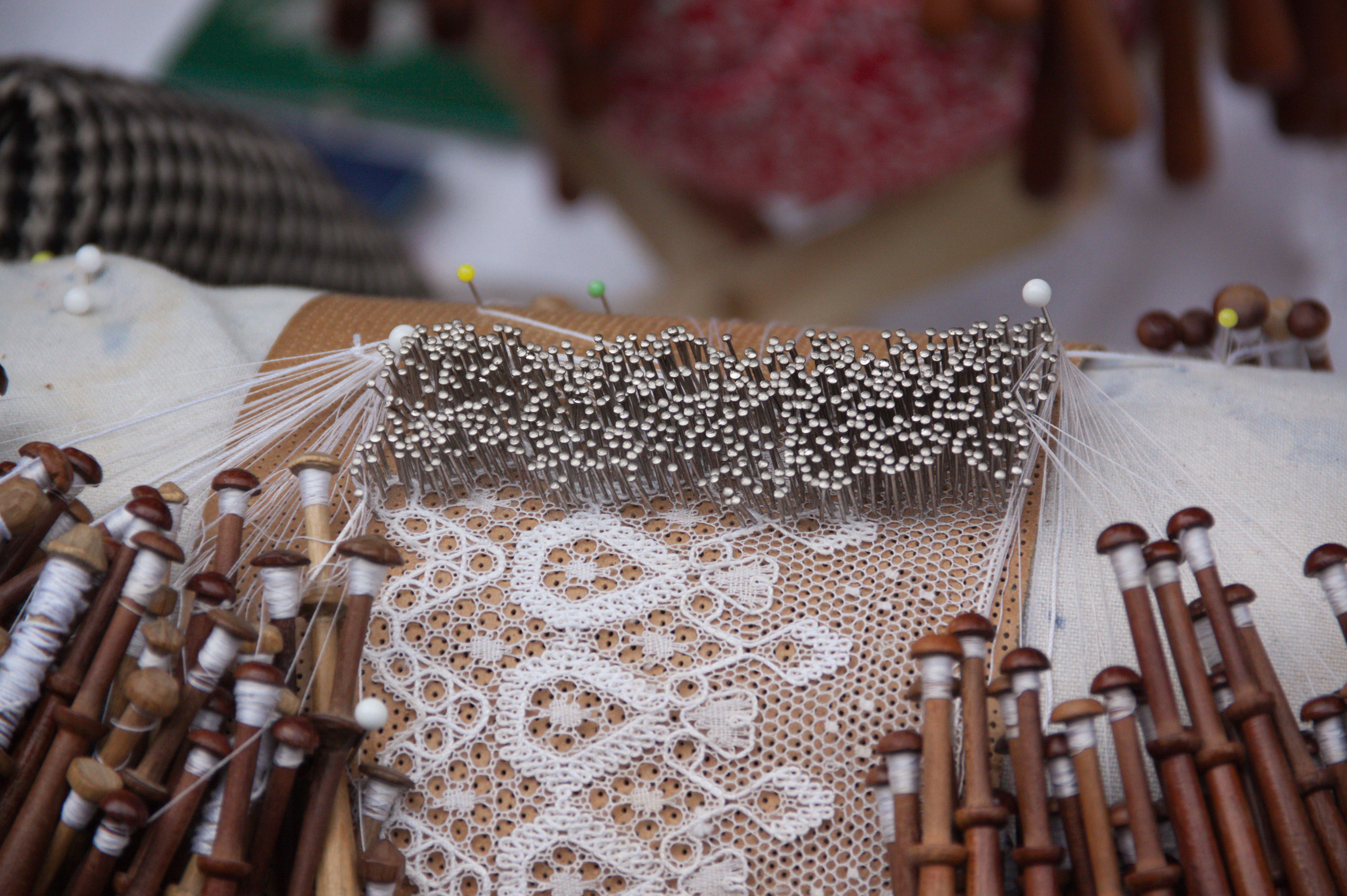
Bobbin lace structure relies on two basic thread movements: the cross and the twist. In a cross, two adjacent threads are exchanged laterally. In a twist, two threads in a pair are rotated around each other. Different combinations of these two actions — applied in different sequences across varying numbers of thread pairs — produce the distinct ground structures and ornamental elements that define each tradition.
Polish regional styles generally use a four-thread working unit. Two pairs of bobbins are handled together. The operative sequence is typically:
- Cross the two middle threads over each other
- Twist each outer pair once or twice
- Cross the two middle threads again to close
- Secure with a pin through the pricking card into the pillow
This sequence is referred to in German-language technical literature as a Schlag (stroke), and variations on it produce the different ground types — whole stitch, half stitch, and their combinations — observable across Polish lace traditions.
Pricking Cards and Pattern Transfer
The spatial plan of a lace design is encoded in a pricking card: a piece of stiff card or paper in which holes have been punctured at every intersection point. The pattern of holes specifies where pins must be placed to anchor thread crossings during work. Historically, pricking cards were produced by a pattern-maker — often a specialist separate from the lacemaker — who transferred a paper design by pricking through it with an awl.
In Koniaków, the pricking card tradition involved transfer of patterns between generations of families. Older card stock was frequently traced and re-pricked to produce working copies, meaning pattern variants developed gradually over decades of use.
The pin placement defined by the pricking card establishes both the density of the ground and the outline of figurative or geometric motifs. The more complex the motif, the larger the number of pin holes and the greater the number of bobbins required simultaneously.
Working Position and the Pillow
Polish lacemakers traditionally work with the pillow positioned on a stand or propped against the thighs. The angle of the working surface affects the direction in which bobbins hang and move, and lacemakers adjust position to maintain an even working tension. In the Silesian Beskids tradition, bolster pillows of cylindrical form are standard. The pillow rotates to bring new sections of the pattern into reach without requiring the worker to move.

Thread Count and Bobbin Numbers
Simple ground structures in Polish lace require as few as six to twelve pairs of bobbins. Designs incorporating independent figurative motifs — flowers, leaves, geometric shapes worked in raised relief — commonly require forty or more pairs to be managed simultaneously. Koniaków lace with pictorial roundels has been documented using over eighty pairs for a single piece.
The organisation of bobbins on the pillow requires that threads are kept in defined order at all times. Experienced lacemakers arrange bobbins in coded groupings — separating pairs working in different sections of the pattern — to prevent tangling and maintain clarity of the working sequence.
Ground Structures Used in Poland
Three ground structures appear across Polish regional lace traditions:
- Whole stitch (toile)
- Dense, cloth-like ground produced by fully crossing and twisting each working pair. Creates solid areas in figurative motifs.
- Half stitch (fond)
- Open mesh produced by omitting the final cross in each stroke. Used for net-like backgrounds in Silesian and Kurpie styles.
- Torchon ground
- Diagonal mesh worked at 45° to the axis of the piece. Appears in geometrically structured pieces from the Kłodzko area.
- Raised work (reliefwerk)
- Figurative elements raised above the ground plane by working additional thread pairs over a padding core. Characteristic of high-quality Koniaków pieces.
Joining and Finishing
When a section of pattern is complete, thread pairs must be secured, cut, and worked into the edge of the piece. Polish lacemakers traditionally sew out the final thread tails with a needle, tucking them under adjacent crossings to prevent unravelling without adding bulk. Edges are typically finished with a simple twisted picot — a small loop formed between the outer pins — which produces the characteristic serrated profile visible on the border of finished lace lengths.
References
For further technical detail, the following publicly accessible resources are relevant:
- Muzeum Etnograficzne w Krakowie — documentary holdings on Silesian and Lesser Poland lace
- Wikimedia Commons: Bobbin lace category — photographic documentation
- UNESCO Intangible Cultural Heritage — policy and documentation framework