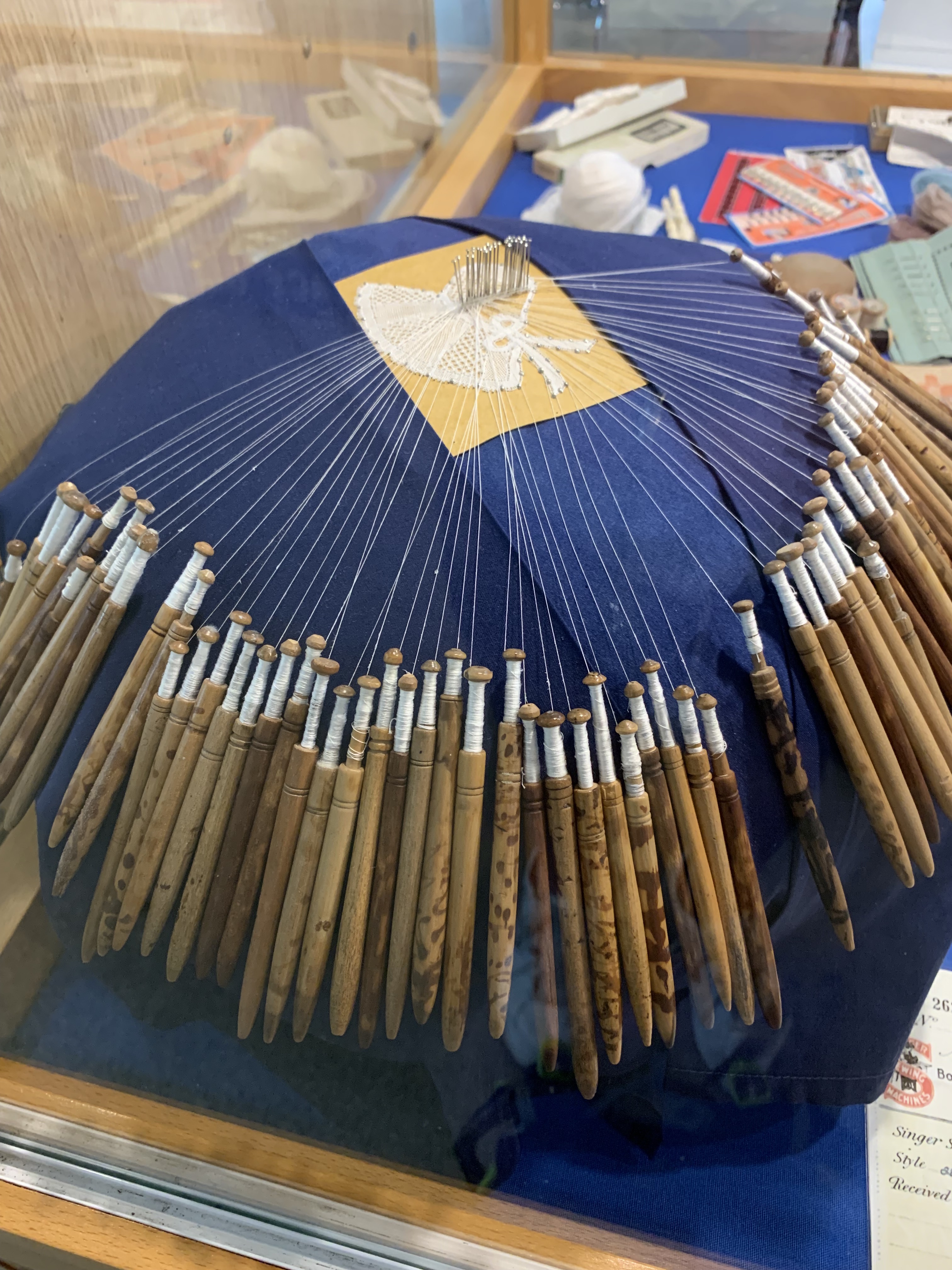
The Pillow
The working surface of bobbin lace is a firm pillow into which pins can be inserted and removed cleanly. In Polish regional lace traditions, two pillow forms are documented:
- Bolster pillow (wałek)
- A cylindrical roll, typically 40–60 cm in length and 15–25 cm in diameter. The standard form in the Silesian Beskids and Kurpie traditions. Rotates to advance the working area.
- Flat pillow (poduszka)
- A cushion of rectangular or oval form, tilted on a stand. Used in some Lesser Poland workshops. Better suited to rectangular lace lengths than to medallion work.
Bolster pillows are stuffed with sawdust, sand, or tightly packed straw. The stuffing must be dense enough to hold a pin vertically against the lateral tension of working threads, but not so hard that pins cannot be inserted and extracted smoothly. The cover fabric is typically a plain-woven cotton or linen cloth in a neutral colour — the surface must not snag threads.
In the Koniaków area, bolster pillows were historically made within the household rather than purchased. The stuffing was adjusted — packed tighter or looser — to suit the individual lacemaker's preferred working tension. A pillow made for one lacemaker was not necessarily comfortable for another.
Bobbins
The bobbin is the thread carrier of bobbin lace. Each pair of bobbins holds the two thread ends that constitute one working pair. The bobbin must be heavy enough to maintain tension on the thread without the lacemaker actively holding it, but light enough to be manipulated rapidly during crossing and twisting sequences.
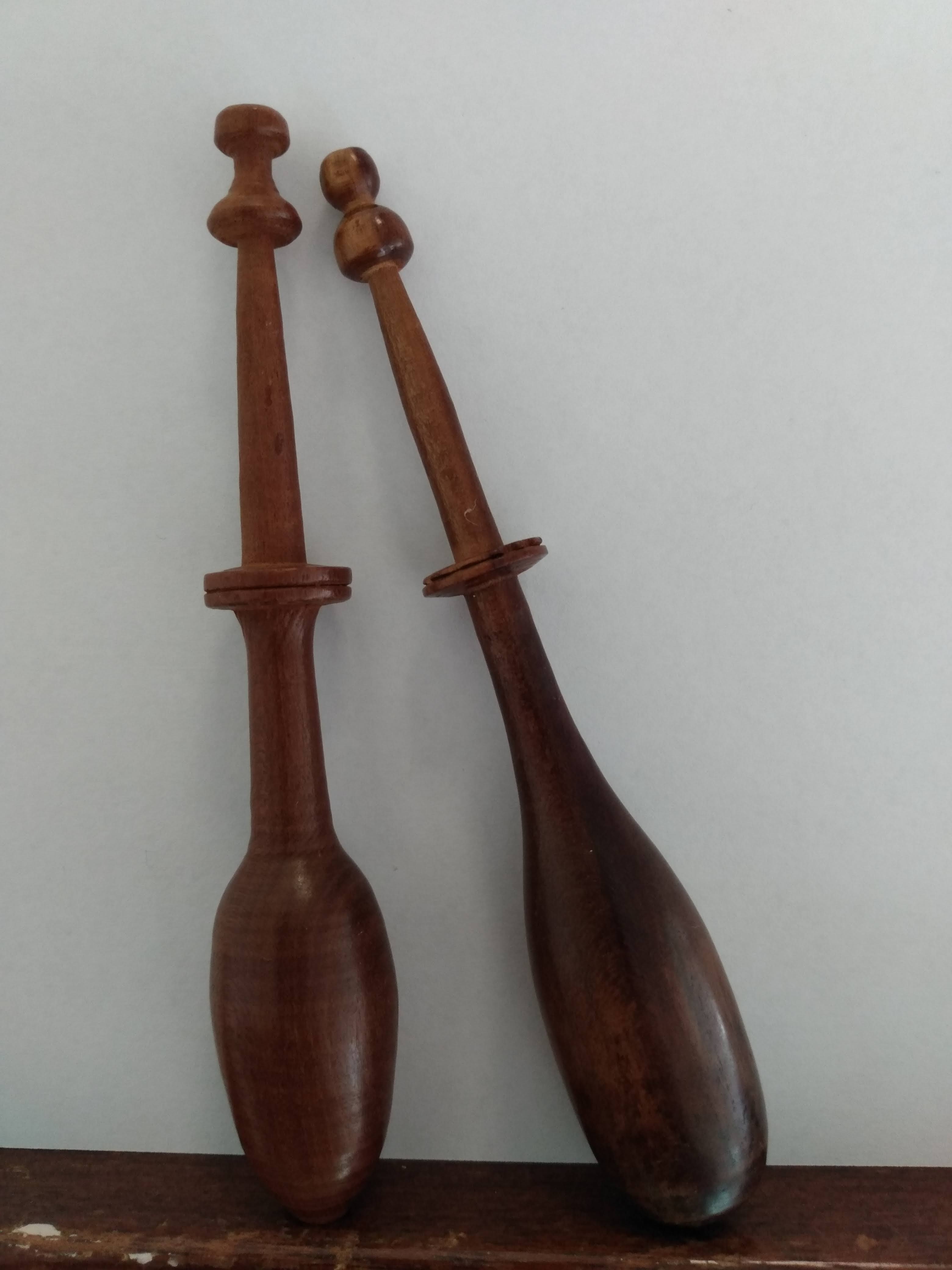
Polish lace bobbins are typically turned from hardwood — boxwood, beech, or fruitwood — and consist of three sections:
- The shank — the upper portion, which the lacemaker grasps between thumb and forefinger to pick up and manipulate the bobbin
- The spool — the central constricted section onto which thread is wound in a figure-eight pattern
- The head — the lower terminus, which adds weight and prevents the bobbin from rolling off the pillow
Thread is wound onto the spool with sufficient quantity to complete a working section, then hitched with a half-hitch over the shank to prevent unwinding during work. As thread is consumed, the hitch is released and more thread drawn off the spool. This sequence — wind, hitch, work, release, draw — is repeated continuously throughout a working session.
The Pricking Card
The pricking card encodes the spatial plan of the lace design. It is a sheet of stiff card or heavy paper in which a pattern of holes has been precisely punctured. Each hole corresponds to a pin placement during work. The arrangement of holes determines where the threads cross and where they are held, and therefore controls the overall shape and scale of the finished piece.
Pricking cards in Polish lace traditions were typically made on card stock heavy enough to resist multiple uses — a pricking card might serve for a dozen or more repetitions of a pattern before the holes enlarged to the point where pin positioning became inaccurate. Worn cards were copied by laying a fresh sheet beneath the original and re-pricking through both layers with an awl.
The making of new pricking cards — designing a new pattern and puncturing a working card — was a distinct skill from lacemaking itself. Some regional centres maintained specialist pattern-makers, while others relied on the lacemakers themselves to design and produce cards. In both cases, the pricking card is the primary carrier of pattern information between practitioners and across generations.
Pins
Steel pins of small diameter — typically 0.5 to 0.8 mm — are used to anchor thread crossings at each hole in the pricking card. The pin must be thin enough to sit within the hole cleanly, without distorting the surrounding threads, and long enough to be gripped and inserted one-handed without the lacemaker losing her working position.
In earlier periods, brass or iron pins were common. Contemporary lacemakers typically use stainless steel or brass-head steel pins. The choice of pin affects working comfort rather than the character of the finished lace, since pins are removed progressively as the work advances and no traces of pinning remain in the completed piece.
Thread
Thread selection determines the texture, density, and appearance of finished lace. Polish regional traditions show characteristic preferences:
- Koniaków
- Fine white cotton thread, tightly twisted. Typically in the range equivalent to DMC no. 80 or finer for detailed figurative work.
- Kurpie
- Heavier cotton, producing a more substantial ground. The heavier thread weight reflects the geometric rather than figurative character of the patterns.
- Lesser Poland
- Historically linen thread was used in some Lesser Poland workshops; cotton became standard during the twentieth century as it became more readily available at lower cost.
- Lower Silesia
- Historical examples show linen as the primary fibre, consistent with Central European lace production standards of the eighteenth and nineteenth centuries.
The twist direction and degree of twist in the thread affects how it behaves when worked into bobbin lace structures. Threads with a Z-twist (twisted clockwise when viewed from above) and those with an S-twist (anticlockwise) will behave differently when worked through crossing and twisting sequences. Matching thread twist direction to pattern type is a consideration for practitioners producing technically demanding work.
The Bobbin Winder
A separate tool — the bobbin winder — is used to load thread onto bobbins from spools or cones before a working session begins. Simple winders are hand-operated frames that hold the thread spool and allow the bobbin to be rotated against it. More elaborate versions use a mechanical ratchet to maintain consistent thread tension during winding. The bobbin winder is a workshop auxiliary rather than part of the lacemaking process itself, but it saves significant time compared with winding bobbins by hand.
Storage and Maintenance
Between working sessions, loaded bobbins are stored on the pillow in working position, with the pricking card pinned in place and work-in-progress covered with a clean cloth to exclude dust. Long-term storage of completed lace involves rolling on acid-free card tubes or folding with tissue interleaving to prevent crease marks. Museum collections typically store historic Polish lace flat in shallow archival boxes with cotton or linen interleaving.